Lessons From the Field: Blind Inlets & Nutrient Management

Every dollar you invest in the field (seed, fertilizer, pesticide, fuel in passes) should be working for you to deliver a return. Those dollars have to earn their keep. That’s not a new concept, but it matters now more than ever. Between market conditions and more severe weather patterns, there’s no room for a practice that doesn’t pay off.
PCM and Missouri Corn recently hosted a field with Dr. Kelly Nelson from the University of Missouri looking at some of the research happening on the Yoder’s farm near Leonard, MO. The research looked at blind inlets, nutrient management, and which practices earn their keep.
A few things came out of that evening that I think are worth sharing:
Blind Inlets
Anyone who has farmed long enough has fixed a riser their employee, brother, or kid has hit (of course, the farmer would never accidentally hit one …). Blind inlets bury a French drain type system under aggregate so that the water can move down, but there is no riser to knock down. You can farm right over the inlet. Additionally, there is no entrance point for animals to crawl in or damage tile.
But the bigger benefit is on water quality: in the research on Yoder’s farm, the blind inlet system has, to this point, collected less phosphorus and nitrogen than the traditional Hickenbottom-style inlet it’s being tested against. The research is still being finalized, but this early signal is a good one.
Dr. Nelson put together a short video walking through how blind inlets work, if you want to see it firsthand: https://youtu.be/vFA07xR_-fM?si=Q9g9gTb2D8erFyxL
Cover Crops Ahead of Corn: The Winning Strategy
Cover crops get talked about like a single practice, but the research says the details matter as much as the concept. In a graduate student trial Dr. Nelson shared, clover and hairy vetch planted ahead of corn performed differently depending on how they were seeded — planting between the rows slightly outperformed broadcast seeding in corn yield.
Termination timing had a more drastic effect: letting clover or hairy vetch persist until corn reached V8 caused a significant yield drag (hairy vetch more so than clover). If you’re planting covers ahead of corn, species selection and termination timing could be the difference between a practice that pays and one that costs you. This is also important in beans, and PCM is here to share the data, plug into research, and help you make the best decision for your dollars on your fields. We help farmers strategically consider both their short and long-term goals for their farm.
Early Data on Biologicals
At PCM, we let the data speak for itself. When it comes to biologicals, current University of Missouri trials have shown no positive yield response.
Testing is ongoing, and if this changes, I’ll be the first to update the farmers I work with.
PMC Data
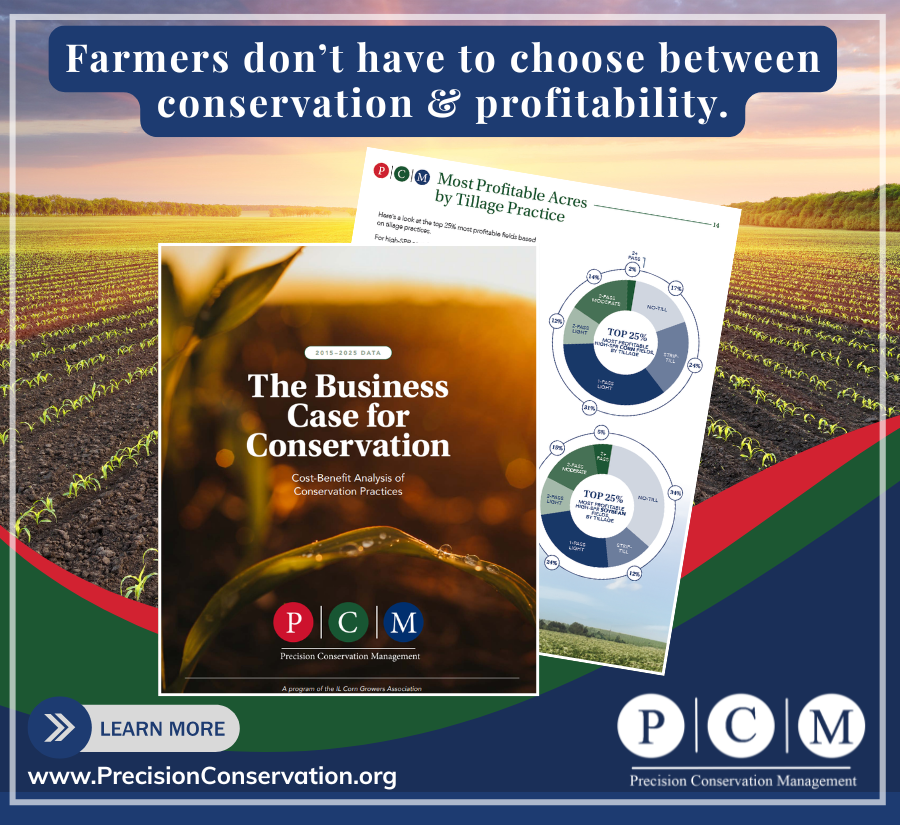
We also got to dig into PCM’s regional data analysis that looks at the financial and environmental impacts of tillage practices, cover crops, and nitrogen management decisions. Attendees really enjoyed seeing the break-downs on practice ROI.
PCM’s goal is to help farmers maximize profitability and implement conservation where and how it makes sense in their operation. It is not a one size fits all approach, and you may find what works on your bottom ground doesn’t work on your hills. Our data analysis looks at each field individually so you can dial into the best practices for each specific location.
If you want to talk about cutting fertilizer over the next ten years, I’m glad to be part of that conversation. If you just want to see how your numbers compare to your neighbors’ and leave it there, that’s fine too. My job is to provide the data analysis and recommendations, but the farmers I work with stay in the driver’s seat – always.
The details are what separate a practice that helps your bottom line from one that quietly costs you, and that’s what I help farmers sort through as a PCM Specialist. We compare data on a field-to-field basis as well as over a 20, 40, or 60 mile radius to see what works for you, what is working for others, and dial into the strategies best suited to help take care of your land and increase profitability.
Enrolling in PCM is free thanks to partners like Missouri Corn. If you’re interested in digging into your own data or discussing the outcomes of this field day give me a call, and my inbox is open!